
We’re excited to announce that Dr. Jeffrey M. Martinez is now offering Genicular Artery Embolization (GAE)—a groundbreaking, minimally invasive treatment for knee osteoarthritis pain.

Knee osteoarthritis is a progressive joint condition in which cartilage and other joint tissues change over time. The knee may become painful, stiff, swollen, and difficult to move.
Osteoarthritis is not simply a matter of wear and tear. Inflammation within the tissue lining the joint can contribute to ongoing pain. Abnormal, small blood vessels may also develop around inflamed areas of the knee.
For patients whose symptoms persist despite appropriate conservative care, Genicular Artery Embolization (GAE) may offer a minimally invasive treatment option. GAE targets abnormal blood flow associated with inflammation without an incision in the knee joint.
Symptoms can develop gradually and may become more noticeable as the condition progresses. Common signs include:
Because knee pain can have several causes, a medical evaluation is necessary before recommending GAE
At Espada Vascular, patients receive an individualized evaluation based on symptoms, medical history, imaging, previous treatments, and personal goals. Jeffrey M. Martinez, MD, considers each patient’s overall health and knee condition before recommending GAE.
Current specialty guidance supports GAE as an option for appropriately selected patients with symptomatic knee osteoarthritis when conservative treatment has not provided enough relief and joint replacement is not desired or appropriate.
Patient is placed under conscious “twilight” sedation for added comfort. This type of anesthesia allows patients to return home the same day.
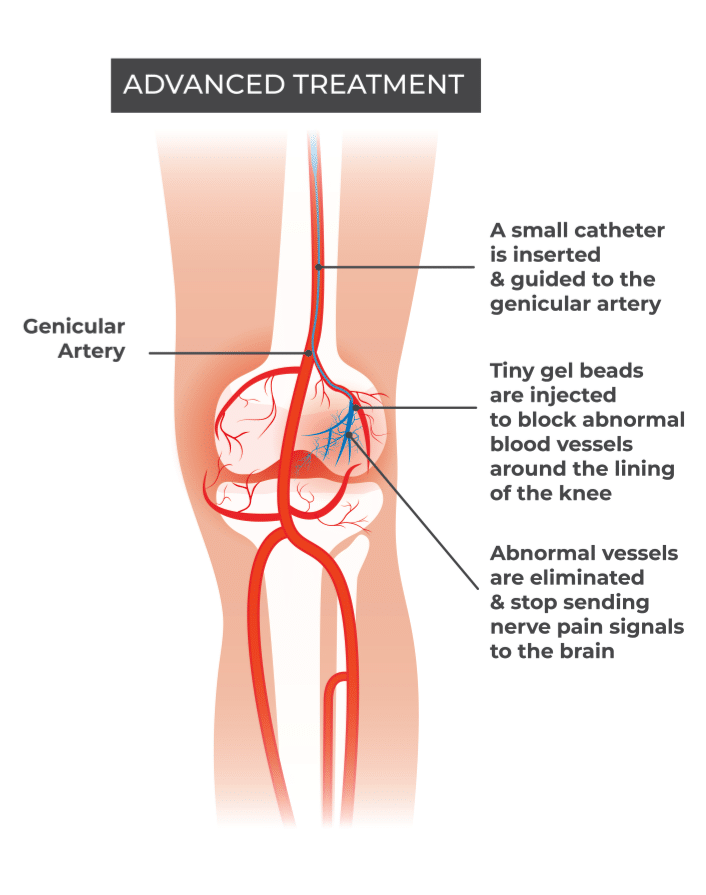
A physician uses x-ray guidance to place a small catheter in the patient’s upper thigh or foot area to access the artery.
The small catheter is guided to the arteries supplying blood to the tissues surrounding the diseased knee.
Once the small catheter is in place, tiny micro particles are slowly injected to slow the blood supply to the affected joint.
Inflammation occurring around the knee is significantly reduced and patients quickly experience pain alleviation.

This short questionnaire will help us understand how osteoarthritis may be affecting your joints and daily activities. Please answer each of the questions below.
Note: This assessment is not a substitute for professional medical evaluation. If you have concerns about your joint pain, stiffness, or mobility, please consult your healthcare professional or contact us to schedule an appointment.
Knee osteoarthritis can develop due to a combination of age, inflammation, joint stress, and prior injury.
Common risk factors include:
Diagnosis begins with a review of symptoms, medical history, prior treatments, and the ways knee pain affects daily life. A physical examination may assess tenderness, swelling, range of motion, strength, and stability.
X-rays are commonly used to identify joint-space narrowing, bone spurs, alignment changes, and other signs of osteoarthritis. Additional imaging may be recommended when needed to confirm the diagnosis or to exclude other causes of pain.
When evaluating a patient for GAE, the physician also reviews overall health, circulation, current medications, and available knee imaging to determine whether the procedure is suitable.
Exercise and physical therapy: Low-impact exercise can strengthen the muscles supporting the knee, improve flexibility, and preserve mobility.
Weight management: When appropriate, reducing excess body weight may decrease pressure on the affected joint.
Medication and injections: Topical or oral medications and selected knee injections may provide symptom relief for some patients.
Activity modification: Adjusting painful activities and choosing lower-impact movement may help reduce stress on the knee.
GAE is an image-guided, catheter-based procedure that targets abnormal blood flow associated with inflammation around the knee. It is performed from inside the blood vessels and does not require open knee surgery or an artificial joint.
During the procedure, the physician guides a small catheter through an artery to the genicular arteries surrounding the painful knee. X-ray imaging and contrast material identify areas of increased blood flow. Tiny medical particles are delivered into the targeted vessels to reduce this abnormal circulation.
Patients are generally monitored after treatment and return home the same day. Recovery is typically brief, and improvement may develop over the following days or weeks.
| Feature | GAE | Exercise and Physical Therapy | Medications and Injections | Genicular Nerve Procedures | Knee Replacement |
|---|---|---|---|---|---|
| Treatment type | Image-guided catheter procedure | Guided nonsurgical care | Medication or injection-based care | Nerve block or radiofrequency treatment | Open surgery |
| Primary target | Inflammatory blood flow | Strength, mobility, and joint stress | Pain and inflammation | Pain-transmitting nerves | Damaged joint surfaces |
| Knee incision | No | No | No | No surgical incision | Yes |
| General anesthesia | No | No | No | Typically no | General or regional anesthesia |
| Hospital stay | No | No | No | Typically no | May be required |
| Typical recovery | Minimal | No procedural downtime | Minimal | Short | Longer, with rehabilitation |
| Preserves natural joint | Yes | Yes | Yes | Yes | No |
| Common use | Persistent pain after conservative care | First-line management | Symptom control | Nerve-related pain treatment | Advanced joint damage |
| Key limitation | Does not rebuild cartilage | May not provide enough relief alone | Relief may be temporary | Does not treat joint damage | Requires surgery and rehabilitation |
GAE is an image-guided, catheter-based procedure that targets abnormal blood flow associated with inflammation around the knee. It is performed from inside the blood vessels and does not require open knee surgery or an artificial joint.
During the procedure, the physician guides a small catheter through an artery to the genicular arteries surrounding the painful knee. X-ray imaging and contrast material identify areas of increased blood flow. Tiny medical particles are delivered into the targeted vessels to reduce this abnormal circulation.
Patients are generally monitored after treatment and return home the same day. Recovery is typically brief, and improvement may develop over the following days or weeks.
To learn more or to schedule an appointment with Dr. Martinez click the button below.